Sequential gearbox: what it is, how it works and why it replaced the H-pattern in rallying
A sequential gearbox is one where the gears go in one after another, always in order. Pull the lever and you go up a gear, push it and you go down one. You can’t jump from second to fifth like you can with an H-pattern: you pass through third and fourth, even if it takes half a second.
It sounds like a limitation, and on a road car it would be. In racing it’s the opposite. Every shift has only one possible movement, always the same one, and under braking there’s no risk of grabbing third instead of fifth. That’s why you find it on motorbikes, on rally cars and on most race cars.
How it works inside: the selector drum
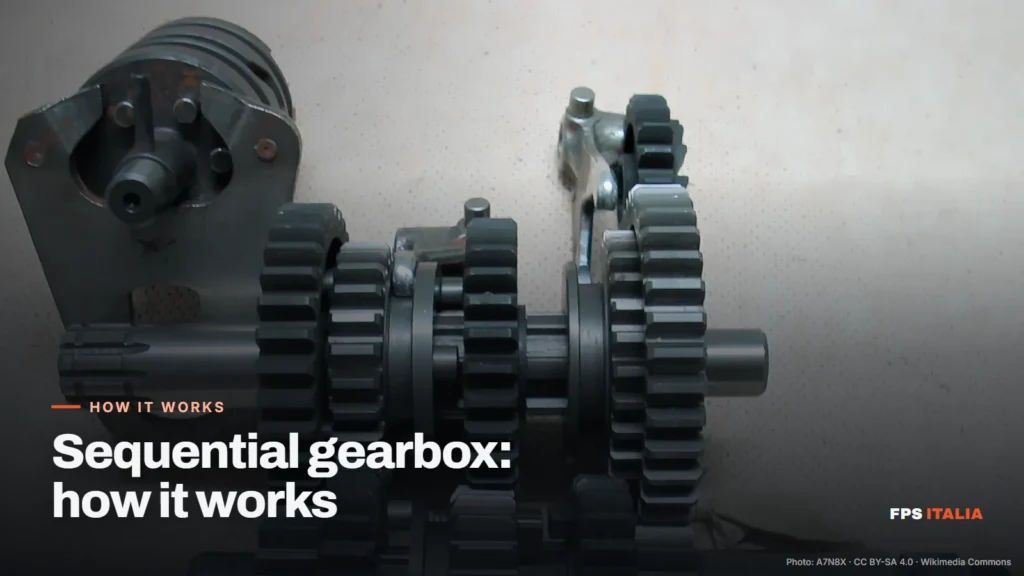
In an H-pattern box the lever moves the selector rods directly. Your arm decides which rod to move and how far. In a sequential there’s an extra part between the lever and the gears: the selector drum, a cylinder with grooves cut into its surface. The grooves don’t run straight, they curve.
Every click of the lever turns the drum by one step. The selector forks run inside the grooves, and as the drum turns the curves push them one way or the other: one fork pulls the old gear out, another puts the new one in. The shape of the grooves sets the order of the gears. It’s also the reason you can’t skip one: the drum only moves forwards or backwards one step at a time.
Racing gearboxes have another difference. The gears don’t engage through synchromesh, as on road cars, but through dog rings with a few wide teeth. They go in instantly, without waiting for the speeds to match. The price is noise, that metallic whine you hear on rally onboards, and wear nobody would accept on an everyday car.
What about the clutch?
On a modern rally car the clutch is used almost only to pull away. On upshifts the electronics cut ignition or fuel for an instant: the load on the gears disappears, the gear comes out and the next one goes in with your foot still on the throttle. On downshifts the ECU blips the throttle to match the revs, the job drivers used to do with a heel-and-toe double declutch.
On motorbikes the principle is the same. Riders have always done clutchless upshifts without any electronics: you just roll off the throttle for a moment.

Sequential vs H-pattern
| H-pattern | Sequential | |
|---|---|---|
| Movement | Every gear has its own slot in the gate | One line only: forwards and backwards |
| Skipping gears | Yes, for example fifth straight to second | No, they all go by, one at a time |
| Missed shifts | Possible | Almost impossible |
| Clutch | On every shift | Usually only to pull away |
| Where you find it | Road cars, classic cars | Motorbikes, modern rally cars, race cars |
Motorbikes have always had one
If you ride a motorbike you already use a sequential, you just work it with your foot. The most common pattern is “one down, the rest up”, that is 1-N-2-3-4-5-6 on a six-speed bike: first goes in by pressing the lever down, neutral sits halfway, and from second onwards you go up by lifting the lever. Every gear goes by, in order, no shortcuts.
And on road cars?
This needs a bit of care, because the word gets used loosely. Plenty of road cars have a lever or paddles “in sequential mode”, but underneath there’s an automatic or a dual-clutch gearbox: the sequence is in the controls, not in the mechanics. The same was true of the automated manuals of the late nineties and early two-thousands, such as Alfa Romeo’s Selespeed, fitted to the 156 and the 147, or BMW’s SMG on the M3. Inside they had a conventional manual gearbox moved by actuators: sequential to use, not to build.
Why it replaced the H-pattern in rallying
A special stage is a continuous chain of braking zones, hairpins, jumps and surface changes. The driver changes gear hundreds of times in a single stage, often sideways with the wheel turned. With an H-pattern every shift means finding a slot in the gate; with a sequential it only means choosing a direction. The arm needs less precision and the head stays on the road and on the co-driver’s notes.
In today’s categories, such as Rally2, the gearbox is a five-speed sequential. The lever sits high up, close to the wheel, with the hydraulic handbrake right next to it. The right hand moves from one to the other in a few centimetres. It’s also why in sim rally the two almost always end up side by side on the rig.
The sequential shifter in sim racing
On a PC or a console a sequential shifter is basically a lever that presses two buttons: one when you pull it, the other when you push it. The game reads them as “gear up” and “gear down”, the same commands as the paddles behind the wheel. What changes is the gesture. With the lever you make the movement you’d make in a car, with the travel and resistance of a real lever, and you leave the paddles to the cars that actually have them.
When it’s worth fitting one:
- if you drive modern rally games (EA SPORTS WRC, DiRT Rally 2.0, Richard Burns Rally, Assetto Corsa Rally) with cars that have a lever in real life;
- if you drift: with the wheel turned half a turn, the paddles are no longer where your hand looks for them;
- if you want the gesture of a real car. For many people that’s the main reason, and it’s a good one.
Setting it up in a game takes a couple of minutes. In the controls menu you’ll find “gear up” and “gear down”: select the first, pull the lever, then do the same with the second and push it. Prefer it the other way round, pushing to go up? Swap the two assignments and the game won’t even notice.
The H-pattern is still the right choice for classic cars and for anyone who wants the clutch on every shift. The two can live together: plenty of people keep the H for classics and the sequential for everything else. On console, with Logitech wheels, the combo and the H shifter use the same port on the wheel; to switch between them without unplugging anything there’s a dedicated extension lead.
Handbrake and sequential in the same base
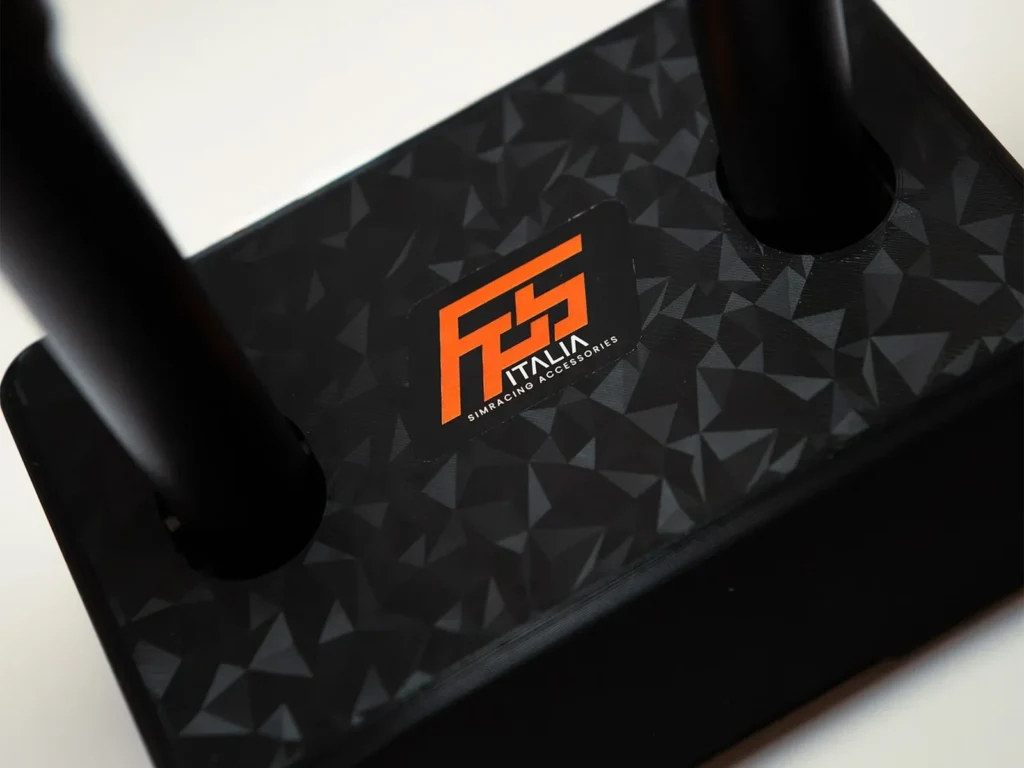
That’s where our combo comes from: a sequential shifter and a handbrake in the same metal frame, at the right distance to move from one to the other without looking. On PC it connects over USB and works with any game that lets you assign controls. On PlayStation and Xbox it plugs into the wheel, with versions for Logitech, Thrustmaster, Fanatec and PXN. Configure it here, choosing platform, knobs and mounting.
Weighing up a handbrake too? The difference between on/off and progressive models is in our handbrake and sequential shifter guide.
Cover photo: dog-engagement gearbox taken apart, by A7N8X, licensed CC BY-SA 4.0, via Wikimedia Commons (cropped, title added).
Frequently asked questions
Can you skip gears with a sequential gearbox?
No. The selector drum turns one step at a time, so every gear goes by, in order. You can, however, shift down very quickly with rapid pulls of the lever.
Do you use the clutch with a sequential gearbox?
In race cars usually only to pull away: on upshifts the electronics cut the ignition for an instant, on downshifts they blip the throttle on their own. On motorbikes, you just roll off the throttle for a moment on upshifts.
Do you pull or push the lever to shift up?
In race cars you usually pull to shift up and push to shift down. In sim racing it's your call: just swap gear up and gear down in the game's control settings.
What's the difference between a sequential shifter and paddles?
For the game, none: they send the same two commands. What changes is the gesture: the lever is worked with your arm and stays put when you turn the wheel, while paddles usually turn with the rim.
Does a sequential shifter work on PlayStation and Xbox?
Yes, plugged into the wheel. The FPS Italia combo exists for Logitech, Thrustmaster, Fanatec and PXN wheels; on PC it connects over USB and works with any game that lets you assign controls.